Emergency Contact Cards for Kids: What Goes in the Backpack and Wallet
What belongs on a child's emergency contact card, where to put it, and how to balance being findable with your family's privacy.
The school has an emergency card for your child. So does camp, and the team, and aftercare. But there's one place none of those cards can reach, and it's the gap between them. The field trip where the bus took a different route. The crowded fair where a seven-year-old turned around and you weren't there. The moment a kind adult is trying to help a child who knows their parents' names but not their numbers.
A small emergency card, carried by the kid, covers that gap. It's a low-tech, two-dollar piece of preparedness that works with no battery and no unlock code. Here's what goes on it, where it goes, and how to do it without broadcasting your family's information to the world.
Advertisement
Ads support the free tier. Paid households are ad-free.
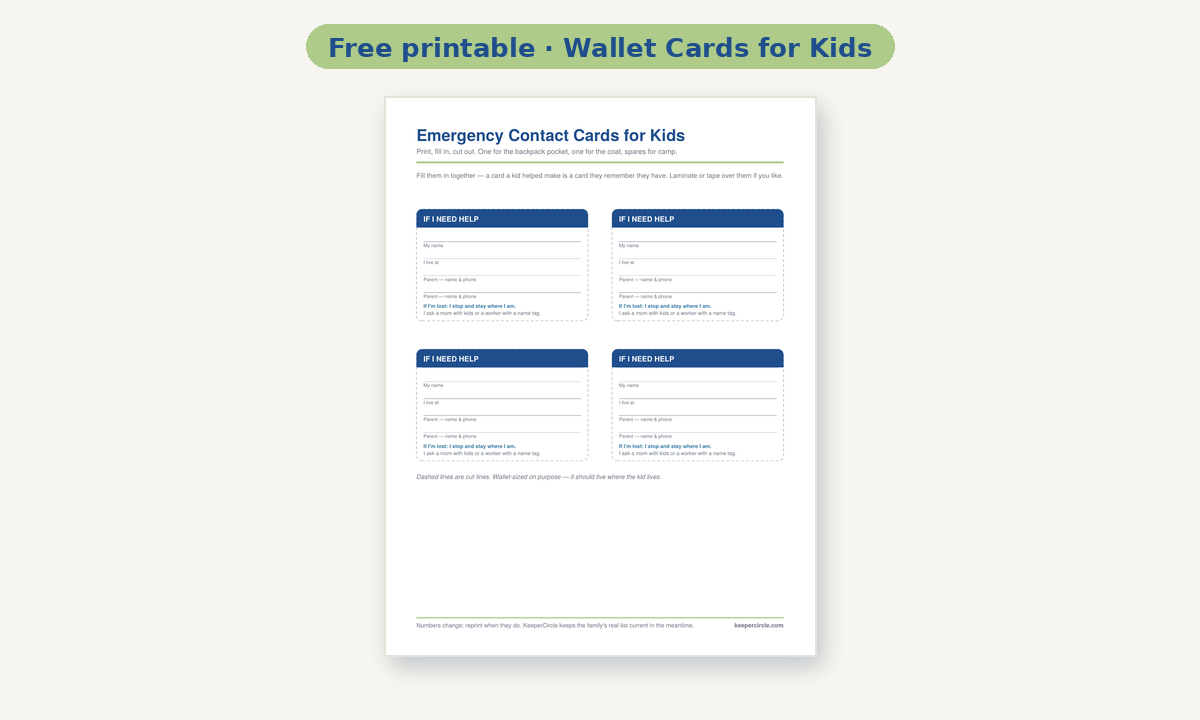
Download the free printable cards (PDF) — four wallet-size fill-in cards per sheet, with cut lines.
What belongs on the card
- Child's first and last name. Young kids especially may freeze on their last name under stress.
- Two parent phone numbers, labeled plainly ("Mom cell," "Dad cell"). Numbers, not just names, because "call my mom" doesn't help a stranger without one.
- One backup adult with their relationship noted, for the scenario where neither parent answers.
- Home address, written out fully.
- Critical medical facts only. A severe allergy or a condition a helper must know ("severe peanut allergy, EpiPen in front pocket"). Skip the full medical history. This card is for the first five minutes, not the hospital intake.
Keep it to what fits on an index card cut in half, in print large enough for a flustered adult to read. If your child is old enough to read it themselves, that's a bonus, since the card doubles as their own reference.
Where the card goes
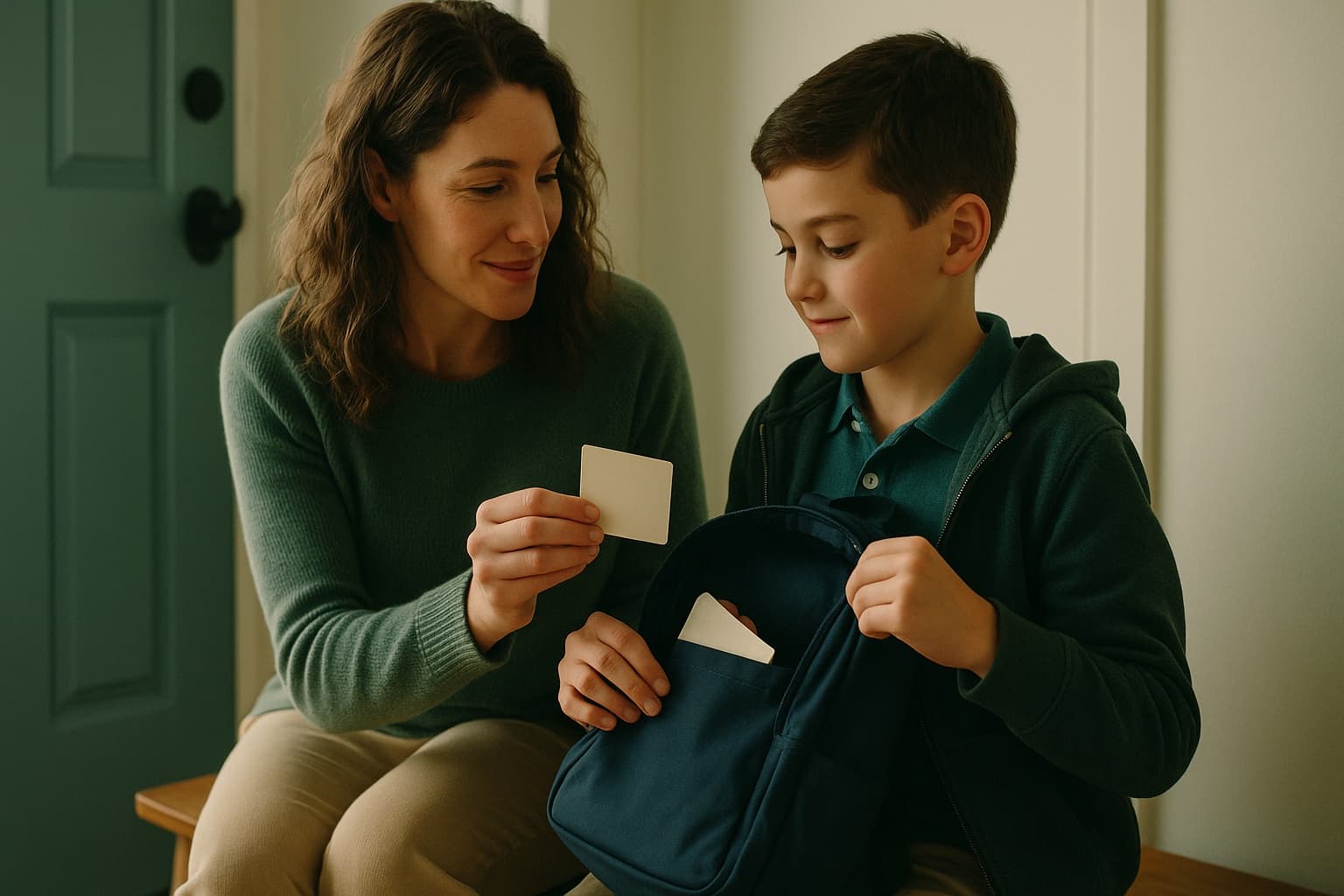
Three placements cover most kids. An interior backpack pocket, always the same one, so your child knows exactly where it lives. A wallet, once they're a wallet-carrying age. And for younger kids on high-separation-risk outings (amusement parks, fairs, travel days), somewhere on their person, like a zipped jacket pocket, or one of the wearable ID options such as a tag laced into a shoe or a slim wristband. Laminate the paper versions or use packing tape, because a card that dissolves in a water-bottle leak protects no one.
The privacy balance
A fair worry deserves a straight answer. Doesn't carrying identifying information create its own risk? The sensible middle ground has two rules. First, nothing identifying on the outside of anything. A visible name on a backpack lets a stranger address your child by name, which is exactly the false familiarity you don't want. The card lives inside. Second, the card holds what a helper needs and nothing more. Names, numbers, address, critical allergy. Not the school name and schedule, not routines, not a photo. Inside a zipped pocket, that information reaches the kind stranger in the moment of need and nobody else.
Teach the card, don't just pack it
A card your child doesn't know about is cargo. Show them where it lives, and rehearse the one sentence that activates it: "If you're lost, find a mom with kids or a worker with a name tag, and show them your card." That "who to ask" instruction matters as much as the card itself. Practice it lightly, the way you practice looking both ways, so it's familiar rather than frightening.
Keeping the cards current
The failure mode of kid-carried cards is the same as fridge lists. They go stale. A number changes, the backup adult moves, and the card in the backpack quietly becomes wrong. Two habits fix it. Refresh cards at natural seams, back-to-school and the start of summer, and regenerate them from a source that's already current rather than from memory. If your household keeps its emergency contacts in a shared list like KeeperCircle, the card is just a two-minute copy-out of information that's already maintained, which is the difference between "update the cards" being a chore and being trivial.
Make them tonight
Index cards, a marker, five minutes per kid, tape or a laminating pouch if you have one. Write the card, place it, teach the sentence, and put a reminder in next August's calendar to refresh it. Small thing, real coverage, done.