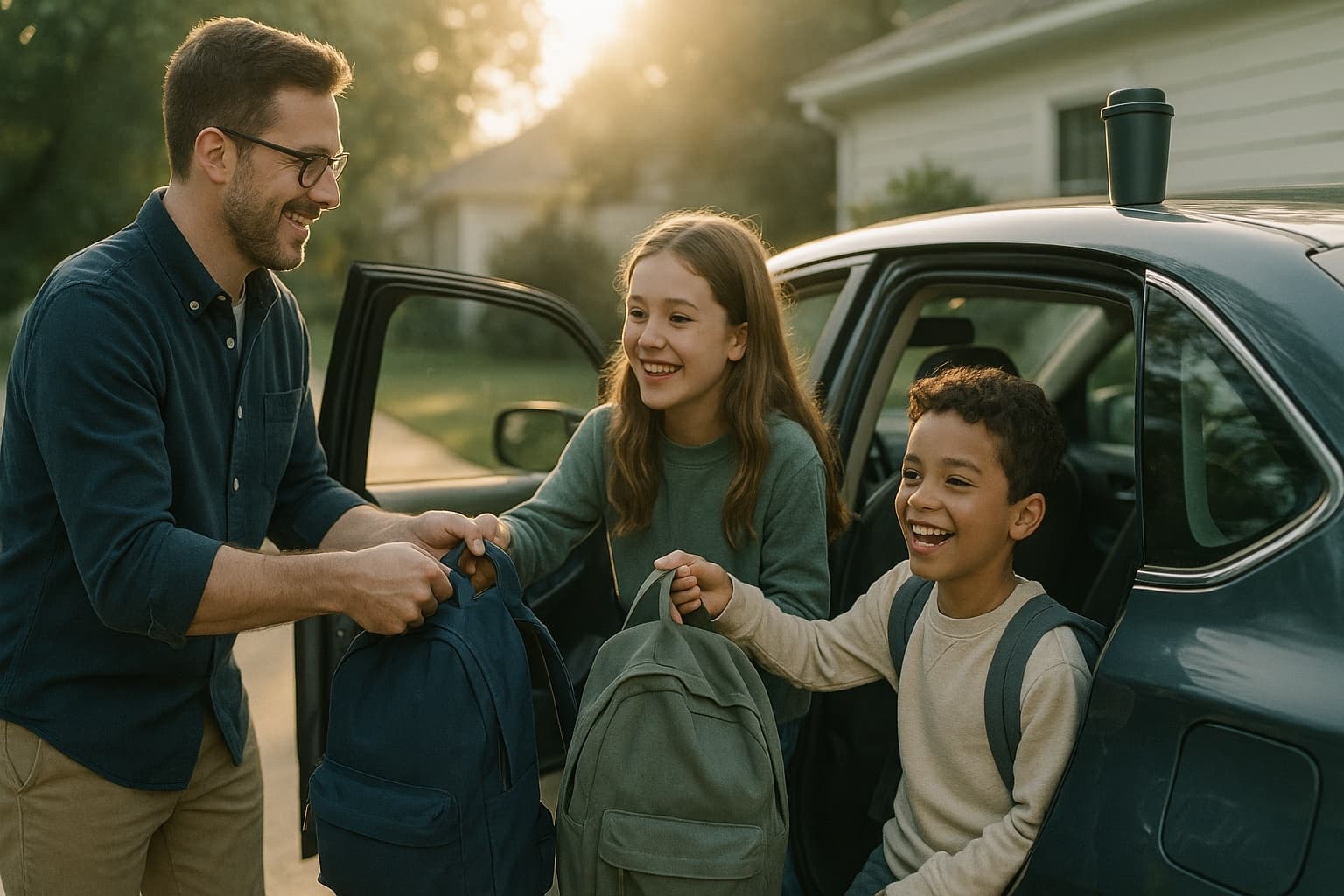
Carpool Coordination Without the Chaos
How to set up a school or activity carpool that survives the season: the contacts, the ground rules, and the backup plan for the day it breaks.
A carpool is one of the best deals in family life. Two or three families each drive a fraction of the time, kids get where they're going, and everyone reclaims hours a week. It's also a small logistics operation running on trust and text messages, which is why every carpool eventually produces the same scene. A kid standing at practice pickup, two parents each certain the other one was driving.
The chaos isn't caused by bad people. It's caused by missing structure. A carpool that runs smoothly has three things nailed down, and all three are cheap. The contact set, the ground rules, and the backup plan.
The contact set: everyone, in every phone
Rule one of carpools, and the one most often broken. Every adult in every family must be able to reach every other adult. Not "my wife has Jen's number." Both parents in every household need the full driver roster, because the day the arrangement wobbles is exactly the day the usual coordinator is in a meeting.
Advertisement
Ads support the free tier. Paid households are ad-free.
For each family in the rotation, capture the essentials once, at setup. Both parents' cells. The home address, with any pickup quirks noted ("use the side driveway, the front one blocks the neighbor"). The kids' names, because texting "I have your son" reads better as "I have Tyler." And the practical details that prevent day-of surprises, like booster seat needs, how many extra seats each car has, and any allergy that matters for post-practice snacks.
This is exactly the kind of information that dies in a group chat and thrives in a shared household contact list. Keeping the carpool families in KeeperCircle, with the numbers, addresses, and notes attached and visible to both parents in your household, means either of you can run the carpool on any given day, which is the entire point of structure.
The ground rules: agree once, coast all season
Five decisions, made out loud at the start, prevent nearly every carpool conflict:
- The schedule, written down. Who drives which days, posted where every family can see it. Verbal rotations decay by week three.
- The confirmation ritual. The night-before text from tomorrow's driver ("I've got pickup tomorrow") is thirty seconds of effort that eliminates the both-thought-the-other-had-it failure entirely.
- The late protocol. How long the driver waits, and who they text, when a kid doesn't show. Deciding this calmly in September beats improvising it angrily in November.
- The swap procedure. Swaps are fine, and swaps are also where carpools break. The rule that works: the two swapping families arrange it directly, then one of them tells the whole group. A swap only half-communicated is a stranded kid.
- The no-show fallback. If the driver hasn't arrived within X minutes, the waiting parent calls, then drives. Named in advance, no drama.
The backup plan: the fourth family
Every carpool should know its emergency driver, the parent outside the rotation who's willing to be called twice a season when illness or a work crisis hits. Ask someone explicitly ("can you be our break-glass driver?"), keep their info with the carpool set, and reciprocate. A three-family carpool with a named fourth is dramatically more durable than one without.
Authorized pickup: the paperwork step
One administrative detail catches families every year. Schools and many activity programs release children only to adults on the authorized pickup list. Every driver in your rotation needs to be on that list for every kid they might drive, and adding someone usually means contacting the office rather than just intending to. Do it at setup, and re-check when the rotation changes.
The mid-season maintenance
Carpools drift. A family's schedule changes, a new kid joins, someone moves. When the rotation changes, update three things in the same sitting: the written schedule, the pickup lists, and the contact set. Sixty seconds of maintenance, and the carpool keeps running on structure instead of memory.
Set up this way, a carpool takes about twenty minutes to establish and almost nothing to run. The kids get rides, the parents get their weeks back, and nobody stands alone at practice wondering where everyone went.